







Contents
Nowadays, home-based exercises for knee pain are gaining significant attention from individuals seeking rapid relief without relying on medication. However, to treat the root cause of knee pain, physical exercise alone is often not enough.
Knee pain is a health condition that can affect anyone, regardless of age. Research shows that a person’s mobility can decrease by at least 30% when facing these issues, significantly impacting their overall quality of life.
When treating knee pain, many people often resort to painkillers. However, long-term use of these medications increases the risk of stomach damage. Consequently, more people are now seeking simple at-home alternatives to replace medication, such as targeted exercise.
To help you gain a deeper understanding, this article will guide you through several simple yet effective knee pain relief exercises.
1. 6 Hidden Gem Exercises for Knee Pain Relief
Typically, specialists classify exercises for knee pain patients into two main groups:
- Stretching Exercises: Aimed at restoring flexibility to the muscles surrounding the knee joint.
- Strengthening Exercises: Aimed at enhancing the body’s support capacity while protecting the knee joint.
>> Read more about: Common causes of knee pain
Among these, the most highly recommended exercises include:
1.1. Calf Stretch Exercise

Stretching the calf muscle group is one of the simplest exercises for knee pain. These movements contribute to improving blood circulation and reducing muscle spasms, thereby alleviating aches in the knee joint.
To perform this at-home remedy, follow these steps:
- Start by standing with your back straight and your feet parallel.
- Step your left foot forward.
- Lean slightly forward and place both hands on the back of a chair for support. Note: Maintain a straight back and keep your eyes looking straight ahead.
- Bend your left knee while keeping your right leg straight. This position allows you to stretch the calf muscle of the right leg.
- Hold this position for 20 seconds, then return to the starting position.
- Repeat 5 times, then switch legs.
1.2. Strengthening Squats

According to experts, performing continuous squats can improve the strength of muscle groups in the thighs, calves, and ankles. This, in turn, helps alleviate the heavy pressure on the knee joints that causes pain.
The steps are as follows:
- Stand with your back straight and your feet shoulder-width apart.
- Bend both knees and lean your torso slightly forward. Note: Always keep your back straight. Additionally, ensure your knees are aligned parallel with your toes (do not let them cave in).
- Hold this position for 10 seconds, then repeat the movement 5-10 times.
- Return to the starting position and repeat the entire set 3 times.
1.3. Hamstring Stretch
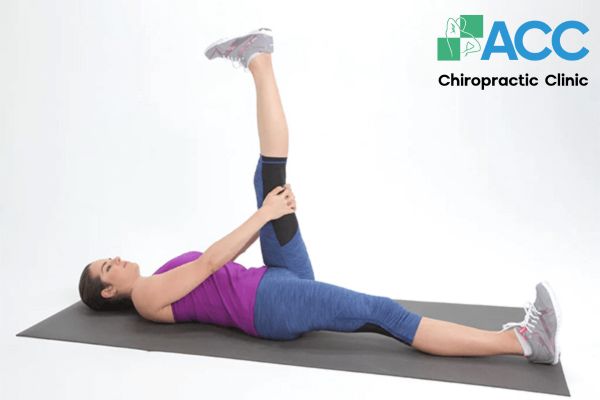
Stretching the hamstring area (the back of the thigh) helps resolve issues with muscle spasms and stiffness. As a result, the pressure on the knee joint is significantly released.
To perform this knee pain exercise, you will need to:
- Lie on your back on a firm, flat surface, such as the floor or a bed.
- Bend your right leg (keeping the foot flat).
- Raise your left leg high. Note: Ensure your left leg remains completely straight.
- Use both hands to hold behind the left knee and gently pull it toward your torso. At this point, try to point your left toes downward (toward your face) to maximize the hamstring stretch.
- Hold the position for 10 seconds, then return to the starting position.
- Switch legs and repeat the movement.
- Repeat the exercise approximately 5 times.
1.4. Quadriceps (Quads) Strengthening Exercise

Experts suggest that the health of the quadriceps (the muscles at the front of the thigh) is closely linked to knee joint pain. Therefore, to soothe knee discomfort, you can try strengthening your quads with the following movements:
- Lie on your back on the floor with one leg bent and the other leg extended straight.
- Lift the straight leg to an angle of approximately 60° relative to the floor.
- Hold this position for 5 seconds, then slowly lower your leg.
- Repeat this movement 5-10 times per set, completing a total of 3 sets.
- Switch legs and repeat the entire exercise.
1.5. Hip Abductor Strengthening Exercise

Instructions for performing the hip abductor strengthening exercise.
Strengthening the muscles on the outer side of the hip and thigh helps improve the stability of the knee joint. This allows the joint to recover more quickly and enhances its ability to withstand pressure, thereby pushing back uncomfortable pain.
Follow these steps to perform this knee pain exercise:
- Lie on your side on the floor or a bed with both legs extended straight.
- Lift your top leg upward to a 60° angle from the surface.
Note: Ensure the lifted leg remains completely straight. - Hold this position for 5 seconds, then lower your leg.
- Repeat 5-10 times per set; perform 3 sets in total before switching sides.
1.6. Triceps Surae (Lower Leg) and Glute Strengthening Exercise
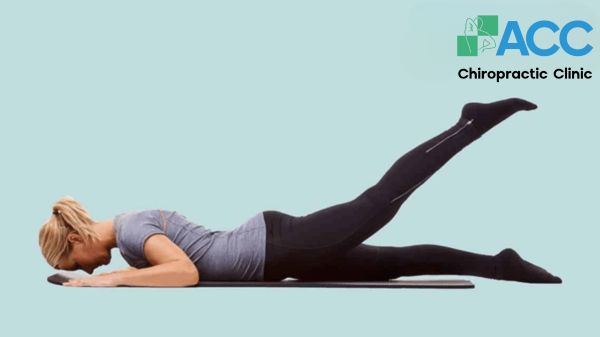
The muscle groups in the thighs and buttocks (including the posterior chain) play a crucial role in supporting the knee. Strengthening these areas can help alleviate knee joint pain effectively.
The steps for this exercise include:
- Lie face down (prone position) on the floor or a bed.
- Lift one leg off the surface. Try to flex your ankle so that your toes point toward your body to maximize the stretch.
Note: Ensure the lifted leg remains completely straight at all times. - Hold the position for 5 seconds, then slowly lower your leg.
- Repeat this movement 5-10 times per set.
- Complete a total of 3 sets, then switch legs.
Watch more: Discover additional knee pain treatment exercises guided by Physical Therapy and Rehabilitation specialists at ACC Clinic:
2. What Should You Keep in Mind When Performing Pain Exercises?
During exercise, if you feel that the intensity of the pain in your knee joint shows no signs of improvement or is becoming increasingly severe, you should consult a doctor promptly. This situation could be a warning sign of a serious underlying health issue.
In particular, for cases where pain persists or recurs frequently, identifying the root cause is crucial so that the patient can receive appropriate and timely intervention.
Typically, knee pain is caused by musculoskeletal conditions such as arthritis, ligament sprains, cartilage damage, or knee osteoarthritis. These issues require more effective treatment methods, such as Chiropractic care, rather than just physical exercise alone.
Unlike general exercise, Chiropractic therapy can treat knee pain at its source by realigning misaligned structures affecting the knee joint. This process releases pressure on nearby nerve roots, leading to significant pain relief.
At ACC Clinic, you can receive effective treatment for knee pain through a comprehensive program that combines Chiropractic care with Physical Therapy and Rehabilitation.
3. Why Should You Treat Knee Pain at ACC Clinic?
ACC Clinic is a leading specialized unit in the field of Chiropractic care in Vietnam. With a team of 100% experienced expatriate Chiropractors, ACC Clinic has successfully treated tens of thousands of patients suffering from musculoskeletal and spinal conditions without the need for medication or surgery.
Furthermore, based on the physical condition and the severity of the pain, specialists at ACC Clinic develop customized treatment protocols integrated with personalized rehabilitation programs tailored to each individual.
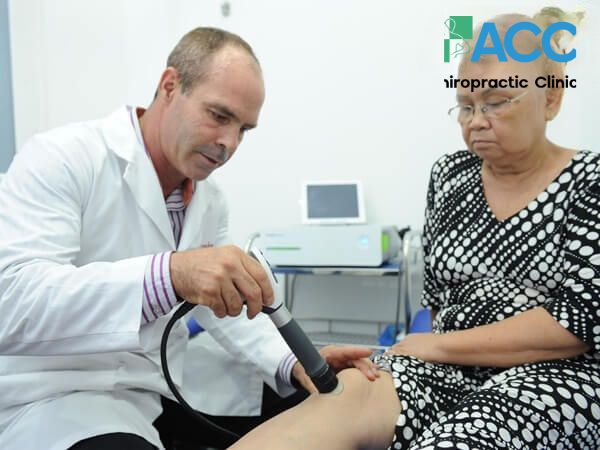
In addition, the state-of-the-art facilities at ACC Clinic are another reason why many patients trust us for their treatment. Advanced technologies such as Shockwave therapy and Class IV high-intensity Laser therapy can help accelerate the healing process of damaged tissues, thereby quickly improving the patient’s quality of life.
In mild cases, you can apply simple at-home knee pain exercises to quickly soothe the discomfort. However, if the pain tends to persist or becomes abnormal, you should promptly contact specialists to receive an appropriate and effective treatment plan.
>> You may also be interested in: